
Last updated August 26, 2026
Free on-site gate assessment - hinges, posts, and your LiftMaster or Nice gate operator checked before anything is quoted
The assessment is free and the quote is the invoice.

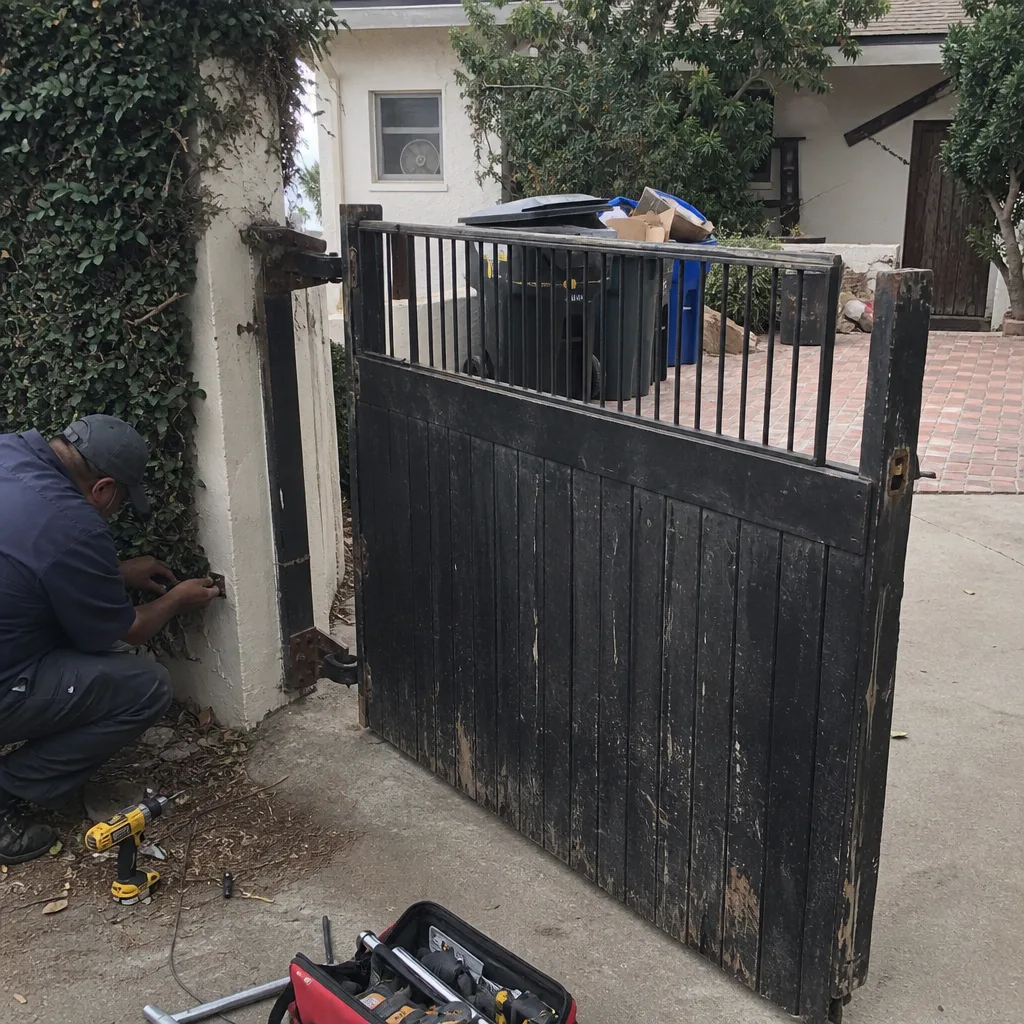 Before
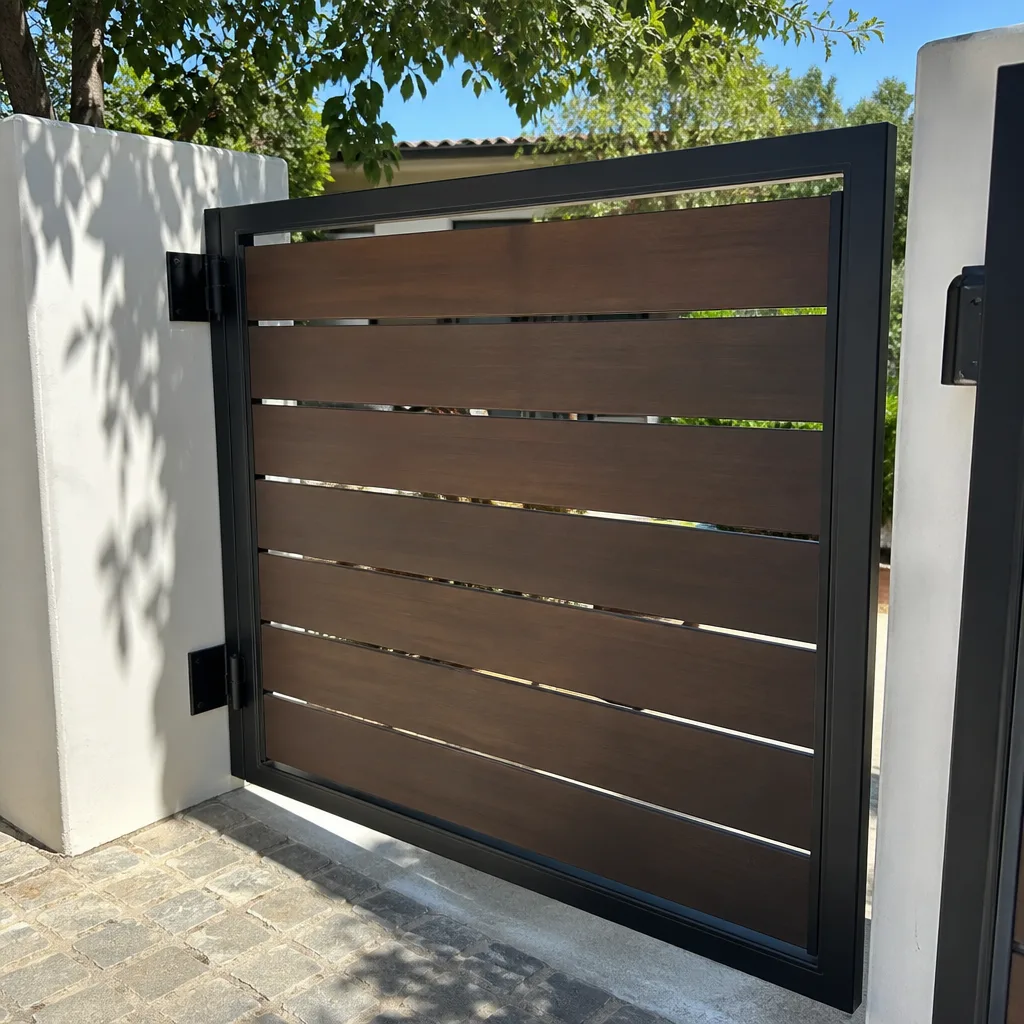 After
After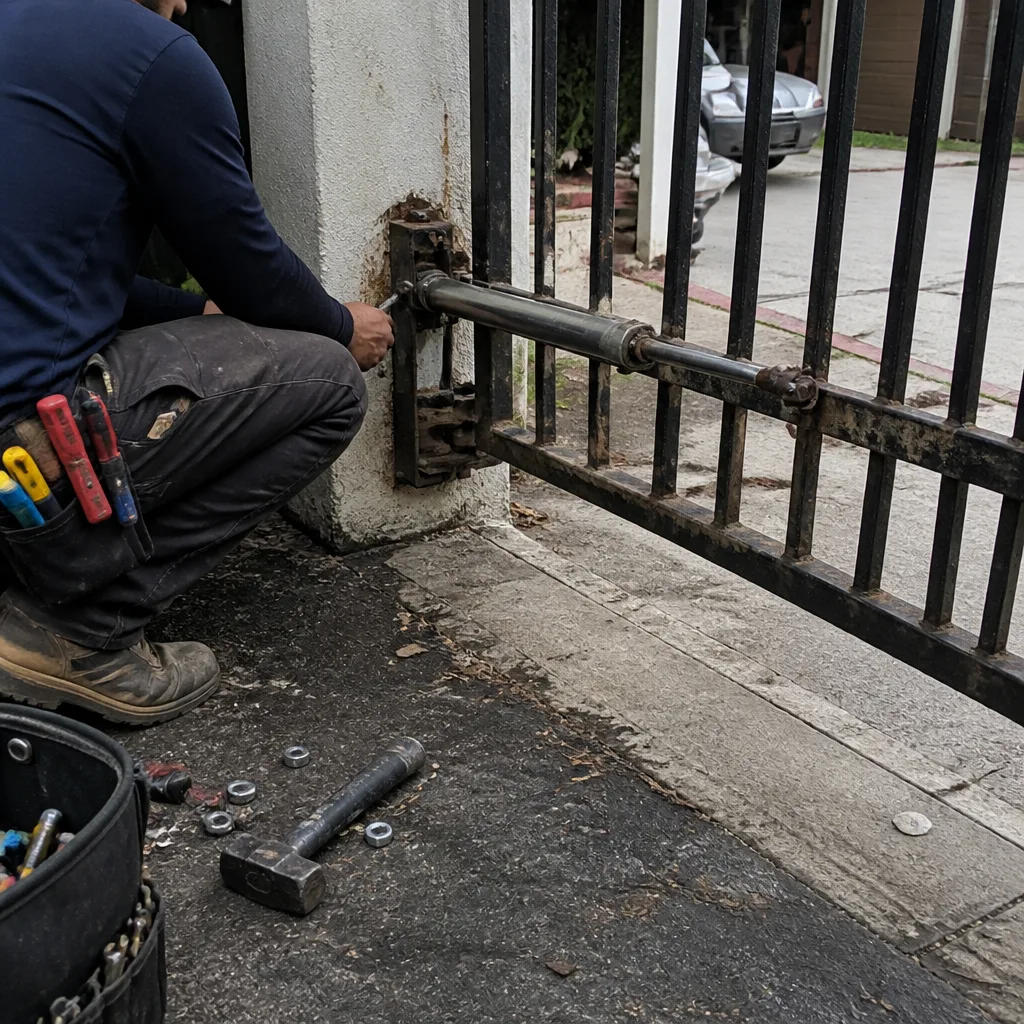 Before
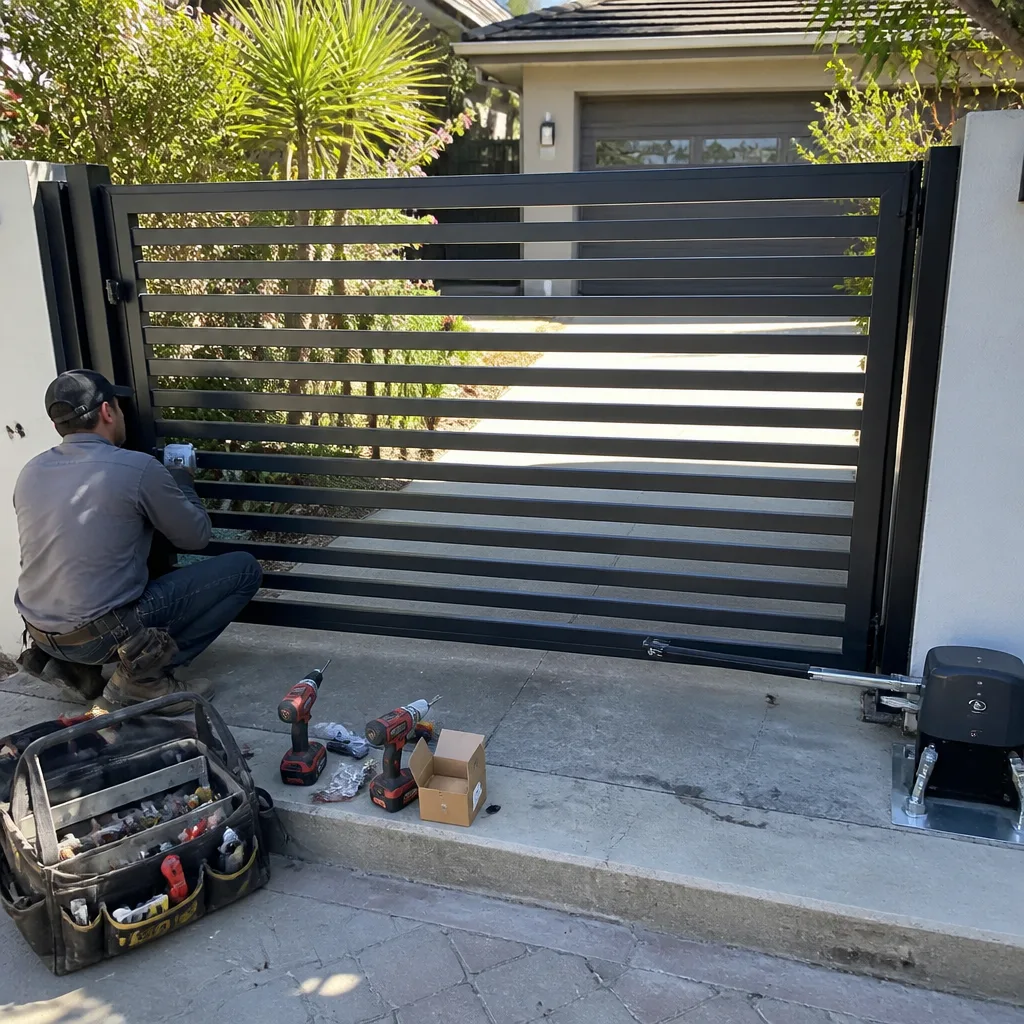 After
After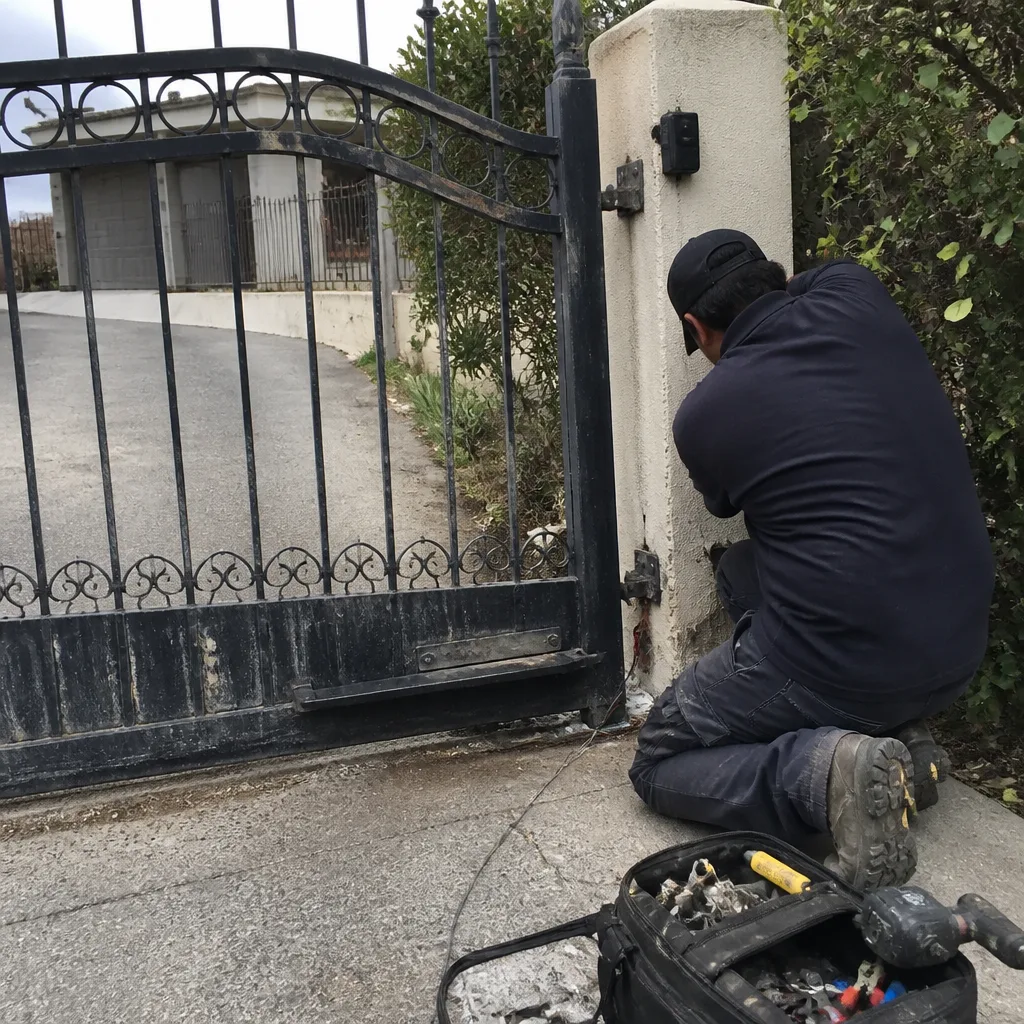 Before
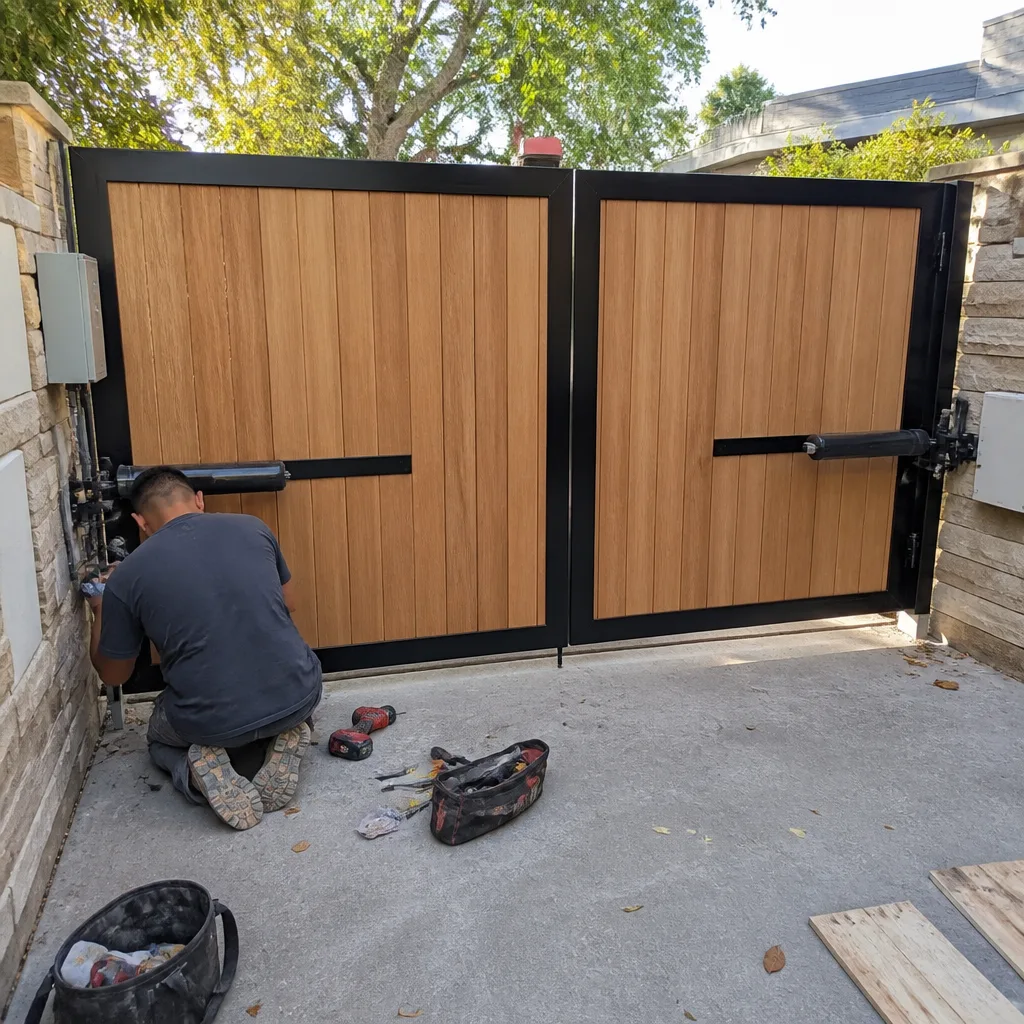 After
AfterGate Repair Warning Signs: A Malibu Homeowner’s Reference Guide
Here’s a fact most Malibu homeowners learn the hard way: an automatic gate almost never dies without warning. It tells you it’s failing, sometimes for weeks, through sounds and movements that are easy to dismiss as “just how the gate’s always been.” A grinding noise on open is not the same problem as a grinding noise on close, and the difference tells me whether you have a month or a weekend before that gate stops working entirely. Most people don’t know that distinction exists. This guide walks you through every warning sign that matters in Malibu, which ones demand immediate attention, and which ones can wait until a convenient Tuesday. For Seasonal Gate Repair Care for Malibu: Year-Round Homeowner’s Guide, see our seasonal maintenance tips.
Quick Answer
The gate repair warning signs that matter most in Malibu are a change in sound (grinding, squealing, clicking, or humming), a change in speed (slower, jerky, or hesitant movement), and visible structural changes (sagging, uneven gaps, rust blooms at hinges, or drag marks on the driveway). Any of these means a component is failing, and in salt-air conditions like Malibu’s, the window between first symptom and full failure is typically two to four weeks. If your gate sounds different than it did last month, that difference is information, and it’s telling you exactly what’s about to break.
Table of Contents
- The Four Sounds a Gate Makes and What Each One Means
- Motor vs. Limit Switch: How to Tell a $90 Fix from a $400 Fix
- Why a Gate That “Mostly Works” Is Days from Full Failure
- Visual Warning Signs on the Frame Itself
- Malibu-Specific Warning Signs: Salt Air, Soil Movement, and Rust Blooms
- What to Do When You Notice a Warning Sign
- Common Mistakes to Avoid
- When to Call a Professional
- Frequently Asked Questions
- The Bottom Line
The Four Sounds a Gate Makes and What Each One Means
Every gate motor has a baseline sound. You hear it hundreds of times a year, and your ear is more attuned to changes than you realize. After our Gate Repair services in Malibu for years, we’ve learned that the sound a gate makes is the single most reliable early warning system you have. Here’s what each sound means.
The Grind on Open
When a gate grinds as it opens but runs quietly on close, the problem is almost always in the chain, gear, or drive mechanism on the pull side. The motor is working against resistance in one direction only, which tells us the strain is directional. This commonly points to a bearing that’s starting to seize, a gear wearing unevenly, or a chain that’s developed a tight spot. On LiftMaster and DoorKing operators, this pattern typically gives you three to four weeks before the component fails completely.
The Grind on Close
A grind that appears only on close is a different animal. The closing direction carries less load, so when a gate grinds on close but opens quietly, the issue is usually in the hinge alignment or a limit switch that’s letting the gate travel too far into the post. The gate is effectively grinding itself against its own stop point. We’ve fixed dozens of these in Malibu where the fix was a $25 hinge adjustment, not a new motor. But left alone, it will chew through hinges and eventually pull the post out of alignment.
The Squeal
A high-pitched squeal is almost always belt slip or a dry bearing. Belt-drive operators like FAAC and BFT units will squeal when the belt loses tension or a pulley develops wear. It’s not an emergency, but it is a clock. The squeal means friction, and friction means heat, and heat means the belt is wearing faster every cycle. Most squeals can be fixed with a tension adjustment and lubrication, but ignore it long enough and you’re replacing the belt and possibly the pulley.
The Click or Hum That Does Nothing
When you press the remote and hear a click or a brief hum but the gate doesn’t move, that’s a different category entirely. The click is the relay engaging. The hum is the capacitor trying to start the motor. Neither is the gate working. This is an electrical warning sign, and it’s one of the few that can go from “huh, that’s weird” to “the gate won’t open at all” in under a week. If your gate clicks and doesn’t move in Malibu, call someone before it becomes a car-stuck-outside situation.
Motor vs. Limit Switch: How to Tell a $90 Fix from a $400 Fix
This is the single most valuable distinction a Malibu homeowner can learn, because the symptoms feel nearly identical from the driver’s seat. The gate stops short of fully open. It reverses before it should. It doesn’t travel the full distance it used to. Both a failing limit switch and a dying motor can cause these behaviors, but the difference in repair cost is significant.
A limit switch tells the motor where to stop. On most Malibu gates, it’s a magnetic or mechanical switch mounted inside the operator housing. When it fails, it sends the wrong signal or no signal, and the gate stops in the wrong place. It might stop three feet short. It might reverse halfway through the cycle. It might open fine but refuse to close all the way. That’s a $90 to $150 fix, and we do it on-site in under an hour.
A dying motor behaves differently when you know what to look for. The gate slows down gradually, not suddenly. It struggles on the same section of travel every cycle. It produces heat you can feel on the operator housing. It might trip the breaker occasionally. When a motor is dying, the entire movement gets labored, not just the stopping point. That’s a $300 to $500 fix depending on the operator.
Here’s the distinction in plain terms:
- Stops in the wrong place but moves at normal speed: likely the limit switch. $90 to $150.
- Moves slower than it used to and the slowness is getting worse: likely the motor. $300 to $500.
- Stops short AND runs slow AND hums louder than before: these are both failing together, which happens when a motor has been fighting a bad limit switch for months.
We’ve had Malibu homeowners show us videos of their gate misbehaving, and with 30 seconds of footage we can usually tell which category it falls into. If you’re not sure, most operators on Mighty Mule and Elite systems store fault codes that point to the answer. But the simple speed-versus-position test is right more often than not.
Why a Gate That “Mostly Works” Is Days from Full Failure
Intermittent operation is the warning sign homeowners ignore most often, and it’s the one that leaves people stranded. The gate opens fine all week, then one morning it doesn’t respond to the remote. You press the button again and it works. You decide it was a fluke. It wasn’t.
Here’s what intermittent operation actually means. Electrical components rarely fail all at once from a state of perfect health. They degrade. A relay gets pitted and occasionally fails to close the circuit. A capacitor loses capacity and can’t always deliver the starting jolt. A connection corrodes until it sometimes passes current and sometimes doesn’t. By the time a gate is “mostly working,” the failing component is already well into its death spiral. It’s not deciding whether to fail. It’s deciding when.
The pattern matters more than the frequency. Here’s what to look for:
- Morning failures: If the gate fails first thing in the morning but works later in the day, that’s a classic capacitor issue. The capacitor has cooled overnight and can’t deliver enough starting power when cold.
- After-rain failures: If the gate misbehaves after a rain, you have moisture getting into a connection or a photo eye. In Malibu’s winter months, this is common and usually points to a failed seal.
- Random failures with no pattern: This often means a control board is developing a hairline crack or a solder joint is failing. These are the hardest to diagnose without opening the housing.
- Works from the remote but not the keypad, or vice versa: That’s a receiver or wiring issue, not a motor issue, and it’s usually a simpler fix than people expect.
The uncomfortable truth is that a gate that fails once has already demonstrated that a component is no longer reliable. The second failure is coming. In our experience at Gatewood Fence & Gate home, the gap between first intermittent failure and complete failure is rarely more than ten days. Some Malibu homeowners have gotten a month. None of them knew which camp they were in until the gate stopped answering entirely.
Visual Warning Signs on the Frame Itself
Not every gate problem is electrical. Some of the most expensive repairs we do in Malibu start with a visual clue that was visible for months before anyone acted on it. The frame tells you things the motor can’t.
Sagging and Uneven Gaps
Stand back and look at your gate. Is the gap between the gate and the post even from top to bottom? If the gap is wider at the top than the bottom, or the gate sits visibly lower on the latch side, you have a structural problem, not an operator problem. A gate sags in the hinge post, not in the middle, and that is where we start. Sagging means the post has shifted, the hinges have worn, or the gate itself has twisted. Running an operator on a sagging gate is like driving a car with a bent axle. The motor is compensating for a problem it wasn’t designed to handle, and it’s wearing out faster every cycle.
Drag Marks on the Driveway
If you see scrape marks or a worn arc in your driveway where the gate travels, the gate is dragging. This is not subtle. Concrete shows the evidence clearly. A dragging gate puts constant load on the operator, overheats the motor, wears the drive gear, and chews through hinges. It also means the problem has been developing long enough to leave physical marks. Fix the panel without the post and you’ll fix it twice.
Rust at the Hinges
Rust anywhere on the gate frame is worth a look, but rust at the hinges is urgent. Hinges are the load-bearing connection between the gate and the post, and when they degrade, the entire weight distribution changes. In Malibu’s salt air, hinge rust develops faster than inland, and it doesn’t announce itself with noise until the hinge is already close to failure. Surface rust is cosmetic. Rust that flakes, bubbles, or shows orange dust around the hinge pin is structural, and the clock is running.
Malibu-Specific Warning Signs: Salt Air, Soil Movement, and Rust Blooms
Malibu is a beautiful place to own a gate and a hard place to keep one working. The same ocean air that makes the light so good is constantly working against every metal component on your property. Here are the warning signs we see in Malibu that you won’t find in a generic gate repair guide.
Rust Bloom Patterns
Salt air accelerates rust, but it doesn’t rust evenly. We look for a specific pattern: rust that blooms at the hinge joints, the bottom rail, and anywhere moisture pools. On Malibu gates, the bottom rail rusts first because it’s closest to the ground and the salt-laden morning dew sits there longest. If you see rust blooms at the bottom corners of your gate, the hinge failure is usually 18 to 24 months behind it. They rust at similar rates because they’re exposed to the same conditions.
Post Lean from Soil Movement
Malibu’s hillsides move. They’ve always moved, and they’ll keep moving. When the soil shifts, gate posts shift with it, and a post that’s out of plumb by even half an inch changes the entire geometry of the gate. The operator works harder. The hinges bind. The latch stops meeting its strike. If you notice that the gate doesn’t line up the way it used to, or the latch has started catching differently, check your posts. A leaning post is a structural issue that needs addressing before the operator fails.
Sluggish Operation After Salt Exposure
Salt air doesn’t just rust metal. It corrodes electrical connections, causes control boards to oxidize, and gums up the lubricant in drive mechanisms. A gate that operates slower in the morning, when it’s been sitting in damp salty air all night, isn’t necessarily a motor problem. It’s often corrosion building up on a connector or a limit switch losing its signal integrity. We’ve opened operator housings in Malibu where the circuit board was covered in a fine layer of salt residue. The gate ran fine for years, and then it didn’t.
If you’re dealing with any of these conditions, a Gate Repair in Malibu specialist who knows the local climate patterns can diagnose faster than someone applying generic fixes.
What to Do When You Notice a Warning Sign
So you’ve identified a warning sign. Now what? Here’s the step-by-step process we recommend for Malibu homeowners, in order of priority. For How to Hire a Gate Repair Contractor in Malibu: A Step-by-Step Guide, see our detailed hiring advice.
- Determine whether the gate still operates safely. If the gate won’t move at all, or it moves erratically in a way that could injure someone, put the operator in manual mode. Most operators have a release handle or key that disconnects the motor. Don’t force an erratically moving gate.
- Document what you’re seeing and hearing. Take a 15-second video of the gate in operation. Record the sound. Note whether the problem is on open, on close, or both. This information cuts diagnosis time dramatically.
- Check the simple things. Look at the photo eyes. Are they clean and aligned? Check the track or driveway for debris. Confirm the gate isn’t physically obstructed. Simple causes masquerade as complex problems more often than you’d expect.
- Look at the frame and posts. Run through the visual checklist from the section above. Sagging? Uneven gaps? Rust at the hinges? These findings change everything about the repair approach.
- Call someone who can tell you the difference. A grinding noise on open versus close is diagnostic. A limit switch versus a motor is diagnostic. A good repair tech will ask you questions before quoting anything, because the right question is worth more than the wrong visit.
If you need a Gate Motor & Opener in Malibu specialist, you want someone who services the major brands and does the work on-site. On-site welding means your gate stays in your driveway, where you can watch the work and ask questions.
Common Mistakes to Avoid
- Lubricating without diagnosing. Spraying a noisy hinge with WD-40 quiets the symptom for a few days and lets the real problem keep getting worse. You’ll fix it twice. We’ve seen it happen over and over in Malibu, where the salt air makes people think everything just needs a little oil.
- Replacing the motor when it’s the limit switch. This is the most expensive mistake because it’s the easiest to make. A gate that stops in the wrong place feels like a motor problem. It’s often a $90 limit switch. Get a second opinion before authorizing a motor replacement.
- Ignoring intermittent failures as one-off flukes. A gate that failed once has proven something is wrong. The second failure is coming, and it’s coming at the worst possible moment, like the morning you need to get to an appointment and the gate won’t budge.
- Running the operator on a sagging gate. The motor will compensate for a sagging gate right up until it burns out. Then you’re paying for both the structural fix and the motor replacement. Fix the structural problem first.
- Assuming rust is cosmetic. In Malibu, rust at the hinges is a countdown. Surface rust you can wipe off is one thing. Flaking, bubbling, or orange dust at load-bearing connections is a structural issue that’s actively weakening your gate.
- Waiting to fix a leaning post. Hill country soil moves, and Malibu’s hills are no exception. A leaning post changes gate geometry, strains the operator, and never self-corrects. The longer you wait, the more components you replace.
When to Call a Professional
Most gate electrical work and all gate structural work falls outside what a homeowner should attempt, simply because the stakes are wrong. A gate under tension can release that tension in an instant, and electricity doesn’t forgive mistakes. Call a professional if your gate is dragging, sagging, leaning, or making any noise that wasn’t there a month ago. Call if it’s moving slower. Call if it’s failing intermittently. The pattern we see in Malibu is clear: homeowners who call at the first sign of trouble spend hundreds. Homeowners who wait spend thousands. Gatewood Fence & Gate offers free estimates in Malibu, call (559) 314-7708.
Frequently Asked Questions
Gate repair in Malibu typically ranges from $90 for a limit switch replacement to $500 for a motor replacement, with most repairs falling between $150 and $350. Structural repairs like post resetting or hinge replacement run higher, usually $400 to $900 depending on the scope. Call (559) 314-7708 for an exact quote, estimates are free.
Intermittent operation means a component is degrading, usually a capacitor, relay, or corroded connection, and it will fail completely within days to weeks in our experience. The exact pattern, like morning failures or after-rain failures, points to the specific component. Don’t wait for it to fail at the worst possible time.
Gate motors in Malibu typically last 7 to 10 years, but salt air exposure can shorten that to 5 to 7 years for operators that aren’t maintained. The motor usually outlasts the limit switch, which often needs replacement at the 4 to 6 year mark. Regular maintenance extends both.
Yes, a sagging gate can often be fixed by re-setting the hinge post, replacing worn hinges, or welding reinforcement on-site, without replacing the gate panel itself. The key is addressing the post and hinge condition, not just propping up the panel. We do on-site welding so the gate never leaves your driveway.
First, check for an obstruction and look at the photo eyes to confirm they’re clean and aligned. Then try the manual release on the operator so you can move the gate by hand and get your car out. Then call (559) 314-7708, and a live person will answer 24/7 to get someone to your Malibu home.
Yes, Gatewood Fence & Gate offers free estimates for gate repair in Malibu, with no trip charge inside the county and $40 off any repair over $200. A live person answers the phone around the clock at (559) 314-7708.
A noisy gate is both, and the noise is the warning. A grinding gate is wearing through a component, and when that component fails, the gate can stop mid-travel, drop, or bind in a way that creates a safety hazard. Noise is the cheapest repair moment you’ll ever have.
The Bottom Line
Your gate talks to you. The sounds it makes, the way it moves, the gaps in the frame, the rust at the hinges, all of it is information about what’s wearing out and how much time you have. In Malibu, the salt air and shifting hills accelerate everything, which means the window between warning and failure is shorter than you’d like. Learn to read the signs. Sound changes on open versus close point to different problems. Speed changes point to motors. Position changes point to limit switches. Visual changes point to structure. If you pay attention to the differences, you’ll catch most problems at the $150 stage instead of the $900 stage. And if you’re not sure what you’re hearing, explore more guides & resources or call (559) 314-7708. A live person answers, and we’ll help you figure out exactly what’s going on.
Written by Hal Gatewood, Owner at Gatewood Fence & Gate, serving Malibu since 2001.